 Forbes
 Business Insider
 HubSpot
 NY Post
 Entrepreneur
 Inc. Magazine
 Fast Company
 Investopedia
 Healthline
 Realtor.com
What is ecommerce link building?
Ecommerce link building means getting other websites to link to your online store. Search engines treat each good link as a sign that your shop can be trusted.
More trust leads to higher rankings for your category and product pages. Higher rankings bring more shoppers. That is why link building has a direct effect on sales for an online store.
Why is link building harder for online stores?
An online store has a problem that a blog does not have. Its most important pages are sales pages, and people rarely link to those.
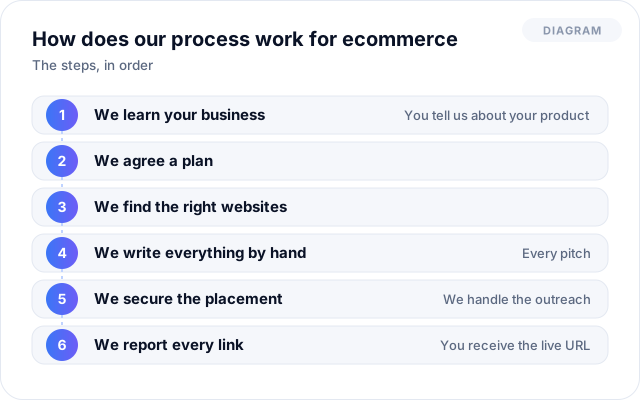
- Product and category pages are commercial, so writers avoid linking to them
- Large marketplaces and big retailers dominate many searches
- Products change, go out of stock or are removed, which breaks links
- Many stores sell similar items with similar descriptions
- Seasonal demand means timing matters
The answer is to earn links in places where a link to a store feels natural, and to use your own guides to pass strength to your sales pages.
Which websites matter most for ecommerce?
- Lifestyle, home, fashion, food and wellness publications
- Gift guides and seasonal buying guides
- Product roundups, such as "best running shoes for beginners"
- Niche blogs and hobby sites in your product area
- Business publications that feature founders and small brands
We have earned placements for consumer brands and experts in publications such as Good Housekeeping, The Spruce, Family Handyman and Elite Daily. Examples are in our placements section.
What do journalists ask ecommerce founders?
- Shopping trends and what customers are buying this season
- How small brands compete with large marketplaces
- Shipping, returns and supply chain problems
- Pricing, discounts and the effect of tariffs
- How to start and grow an online business
- Product advice in your niche, such as skincare, pets, food or home
- Sustainability and packaging
A founder who knows their product and their customers has plenty to say on these topics. We turn those answers into quotes through journalist outreach.
Which link building methods work best for ecommerce?
- Journalist outreach, so the founder is quoted in lifestyle and business media
- Guest posting on niche blogs, with links to category pages or buying guides
- Brand mention link building, because stores are often named in roundups without a link
- Link insertion into existing guides about your product type
Brand mentions are especially valuable for stores. If a writer has already listed your product, asking for the link is a small request.
Which pages should an online store build links to?
- The homepage, for brand authority
- Main category pages, which usually bring the most search visitors
- Buying guides and how-to articles
- Size guides, care guides and comparison pages
- About and story pages, which reporters like to link to
A strong buying guide can do two jobs. It earns links more easily than a product page, and it links on to your categories and products.
How does link building help online stores in AI search?
Shoppers now ask AI tools questions such as "what is a good gift for a new dog owner". The tool suggests products and brands it has seen recommended in trusted places.
Mentions in gift guides, product roundups and expert articles are what put a brand in those answers. See our section on AI search visibility for how this works.
What mistakes do online stores make with link building?
- Pointing every link at product pages with keyword heavy anchor text
- Buying links from coupon and deal sites of poor quality
- Sending free products in exchange for links without care for the rules on disclosure
- Ignoring broken links to products that no longer exist
- Starting link building only weeks before the peak season
Seasonal stores should begin several months early. Links need time to be found and counted before the busy period.
How does our process work for ecommerce link building?
We follow the same six steps on every campaign, and adjust the detail to your market.
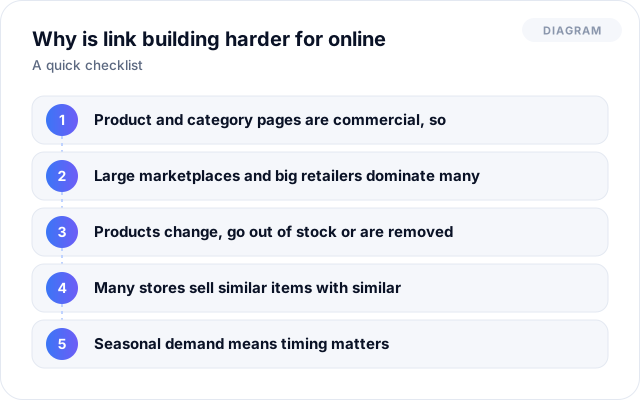
- 1
We learn your business
You tell us about your product, your customers and the pages you most want to rank. We also review your current links and your main competitors.
- 2
We agree a plan
We recommend a mix of methods and explain what each one is for. You approve the plan before any outreach begins.
- 3
We find the right websites
We look for publications and websites that your buyers read, and check each one for real visitors and real editorial content.
- 4
We write everything by hand
Every pitch, expert answer and article is written for that one opportunity, in plain and clear language.
- 5
We secure the placement
We handle the outreach, the follow-up and any edits the publisher asks for.
- 6
We report every link
You receive the live URL, the domain rating, the anchor text and the context of each placement.
What quality standards do we follow?
- Real websites only, with real visitors and real articles
- Relevant sites and relevant pages, so the link makes sense to a reader
- No private blog networks and no link farms
- Natural anchor text, not one keyword repeated in every link
- Honest reporting, so you always know what you received and where
Publishers control their own sites. They decide how a link is labelled and whether an article stays online. We tell you what we see and we do not hide it.
How do we choose anchor text?
Anchor text is the clickable wording of a link. It tells readers and search engines what the linked page is about.
We keep it natural. That means a mix of your brand name, plain descriptive phrases and a smaller share of keyword based wording. Repeating one exact keyword in every link is a clear sign of manipulation, so we do not do it. In journalist placements, the reporter chooses the wording, which keeps the profile natural by default.
Is ecommerce link building right for your business?
It is a good fit for online stores when these points are true.
- You have a website that is ready to receive visitors and turn them into enquiries or sales
- You can put a named person forward as an expert, or you have useful content to offer
- You are prepared to invest for several months, not a few weeks
- You want links you would be comfortable showing to a customer
It is not the right choice if you need hundreds of links in a month, or a guaranteed ranking by a fixed date. Nobody can honestly promise either. If your site has technical problems or very thin content, fix those first, because links cannot make up for a page that does not answer the search.
How do we measure results?
We report what was delivered, and we help you see what it changed.
- Links delivered, each with its live URL so you can check it yourself
- The authority and relevance of every linking site
- Which of your pages each link points to
- Movement in rankings for the keywords you care about
- Organic visitors, and the enquiries or sales they bring
The first three are facts you can verify on the day a link goes live. The last two take time and depend on more than links, including your content and your competitors. We look at the trend over months and tell you plainly what we see.
What do you get?
- A plan built for your website and your goals
- Hand written pitches, answers or articles
- All contact with reporters, editors and site owners handled for you
- A dedicated account manager
- A report for every placement, with the live URL
How long does it take to see results?
We begin within 24 to 48 hours of onboarding. With journalist outreach, most clients receive their first placement within two to four weeks. Guest posts and link insertions depend on how quickly site owners reply.
After a link goes live, search engines need time to find it and adjust. Ranking changes often begin to show within 60 to 90 days of placement. Link building works best as steady work over several months.
How much does ecommerce link building cost?
Journalist outreach uses our three fixed packages.
- Starter: $1,250 for 5 guaranteed links
- Premium: $2,300 for 10 guaranteed links
- Growth: $3,000 for 15 guaranteed links
All packages target DR 50–99 publications and include a money-back guarantee if we do not deliver. Guest posting, link insertion and brand mention work are quoted for each client. Compare the packages in our pricing section or send us your details.