
This article is part of our how to pitch journalists guide.
Why do numbers work?
Journalists need evidence. "Sales rose" is an opinion. "Sales rose 18% after we changed the checkout" is a fact a reader can picture.
Where can you find data?
- Your own sales, customer or support records
- A short survey of your customers
- Patterns you see across many clients
- Public sources, clearly credited
Your own data is best, because no one else has it.
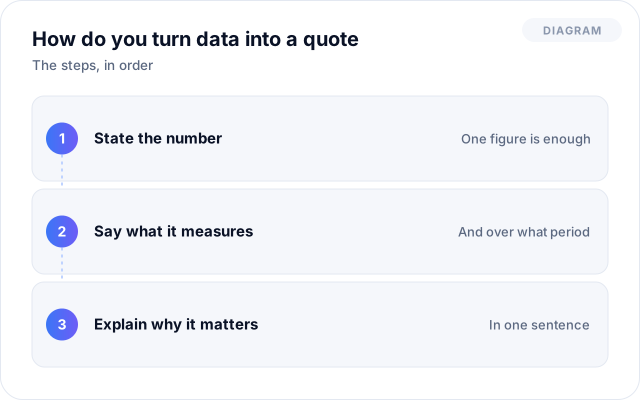
How do you turn data into a quote?
- 1
State the number
One figure is enough.
- 2
Say what it measures
And over what period.
- 3
Explain why it matters
In one sentence.
Example: "About a third of the home sellers we spoke to last year chose a faster sale over a higher price. Certainty mattered more to them than the last few thousand."
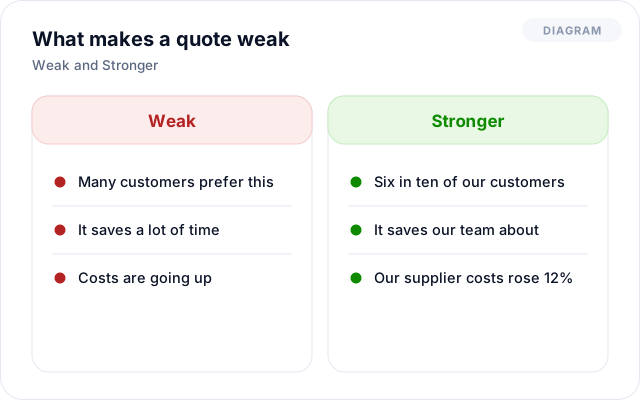
What makes a quote weak?
| Weak | Stronger |
|---|---|
| Many customers prefer this | Six in ten of our customers chose this |
| It saves a lot of time | It saves our team about four hours a week |
| Costs are going up | Our supplier costs rose 12% this year |
How do you stay honest?
- Use real figures only
- Round sensibly and say "about" when you do
- Be ready to explain where the number came from
- Do not present a small sample as a national trend
This approach is central to our HARO links pitches.
What should you read next?
Frequently asked questions
What if I have no data?
Use a specific example from your work instead. A real story is better than a made up number.
Can I share client data?
Only in a form that cannot identify anyone, and only if you are allowed to.