
This article is part of our HARO link building guide.
Why does HARO suit startups?
- Journalists care about expertise, not company size
- Founders have real stories about building something new
- It costs time, not a large budget
- Press mentions help with investors and customers too
What can a founder talk about?
- Starting and funding a company
- Hiring a first team
- Lessons from early mistakes
- Trends in your industry
- How you use new tools and AI
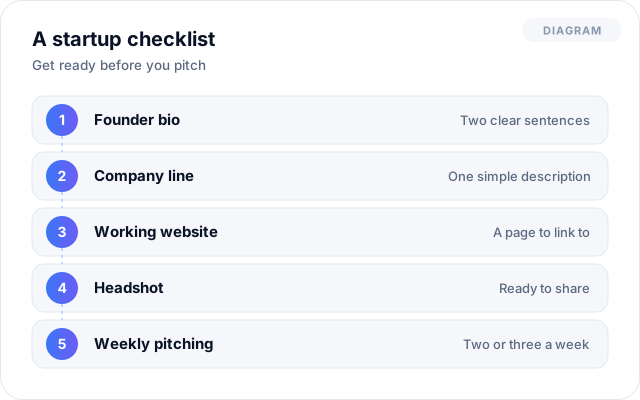
What should a startup prepare?
- 1
A clear founder bio
Two sentences on who you are and what you built.
- 2
A simple company description
One line anyone can understand.
- 3
A working website
With a clear page to link to.
- 4
A headshot
Journalists often ask for one.
What results are possible?
One software client started with a Domain Rating of 3. Nine months later it was 39. Read the SaaS link building case study.
Results vary and are not promised.
What is the founder's advantage?
Journalists like founders because they have first-hand stories. They have built something, hired people and made mistakes. That experience is exactly what a reader wants.
A founder also has more freedom to speak. A large company often needs approval for every sentence. A founder can reply within the hour.
What stories do startups tell best?
- How you decided what to build first
- What you got wrong in the first year
- How you hired your first employees
- How you use AI tools in a tiny team
- How you found your first hundred customers
Journalists want specific, honest detail. A startup story that includes a failure is more likely to be used than a polished success story.
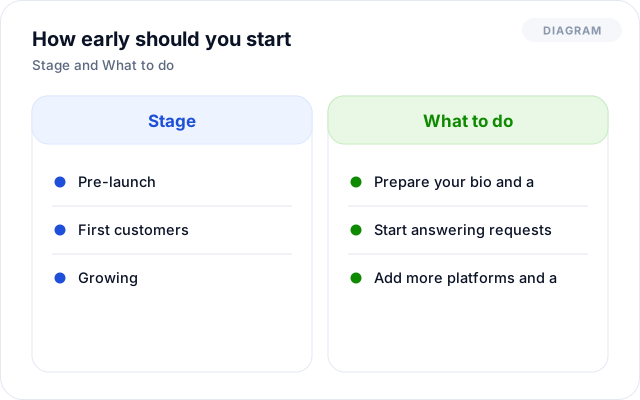
How early should you start?
| Stage | What to do |
|---|---|
| Pre-launch | Prepare your bio and a simple site |
| First customers | Start answering requests |
| Growing | Add more platforms and a second expert |
Links take time to count. The earlier you begin, the sooner they work for you.
How do you avoid looking like spam?
- Use your real name and role
- Keep your website live and clear
- Do not claim traction you do not have
- Answer only on topics you know
Honest, modest bios work well. "Founder of a three person software company" is better than an inflated title.
What results can a startup expect?
Our software client started at Domain Rating 3 and reached 39 in nine months. The SaaS link building case study has the detail. Results depend on many factors and are not promised.
A realistic aim for the first quarter is a handful of placements and a stronger brand footprint.
Should you pitch yourself or use a service?
Most founders start themselves, then hand it over once they realise how many hours it takes. Both paths work. If you choose help, make sure you approve every quote.
See our HARO link building service.
What should be on your website before you pitch?
- A homepage that explains the product in one sentence
- An about page with the founder's name and photo
- A blog or resources page, even if small
- A contact page
Journalists check. A thin site can cost you the quote.
How do you build credibility without a big name?
Be specific. Share your actual numbers, your actual mistakes and your actual choices. Honest details are more credible than polished claims.
Include a line about your background, such as years in the industry. Even a short history shows you have earned the right to comment.
What is the first month plan?
- 1
Week 1
Finish your bio, headshot and site checks.
- 2
Week 2
Sign up to two platforms and send three pitches.
- 3
Week 3
Send three more and note which topics get replies.
- 4
Week 4
Track mentions and adjust.
What should a startup avoid?
- Exaggerating your size, funding or users
- Speaking for areas you have not yet worked in
- Using vague buzzwords instead of facts
- Pitching your product instead of answering
Journalists are used to startup hype. Plain honesty stands out.
How do you measure progress as a startup?
| Measure | Why it matters |
|---|---|
| Placements per month | Shows consistent effort |
| Linking websites | Shows growing authority |
| Brand searches | Shows awareness |
| Organic visits | Shows search effect |
Do not worry about rankings in the first month. Look at placements and brand mentions first.
What happens when a startup keeps going?
The first placements are a milestone. After that, each one builds on the last. A journalist who has seen your name in another article feels safer quoting you. Investors, partners and customers who search for you find a growing trail of coverage.
- Your name appears next to your topic in several places
- Your site gains links from trusted publications
- Your pitches get easier because you have proof
- New journalists approach you directly
That momentum is the real prize. It is hard to buy and easy to lose by stopping, so keep a steady rhythm.
Should founders do it themselves?
Many try. Most stop, because daily pitching competes with running the company. A service keeps it going while the founder approves the quotes.
See our HARO link building packages.
What should you read next?
Frequently asked questions
Do journalists quote unknown companies?
Yes. They quote useful people. Many sources in major publications run small companies.
When should a startup begin?
As soon as the website is live and the product is real.
Does my startup need funding first?
No. You need knowledge and a working website.
Can a solo founder do this alone?
Yes. Plan for about an hour a day.
Should co-founders each have a profile?
Yes, if they have different expertise. Do not create profiles for people who will not be quoted.