
What is HARO link building?
HARO stands for Help a Reporter Out. Journalists post requests when they need an expert for a story. You reply with a short, useful answer. If the journalist uses it, your name and company appear in the article, usually with a link.
That link is called an editorial backlink. Nobody pays for it. The journalist chose to include you. Search engines trust these links because they are hard to get.
Does HARO still exist in 2026?
Yes. HARO has changed owners and names, but it is running again. Many reporters also use similar platforms such as Qwoted and Featured. A good campaign watches all of them.
Read the full story in what is HARO and is HARO still active.
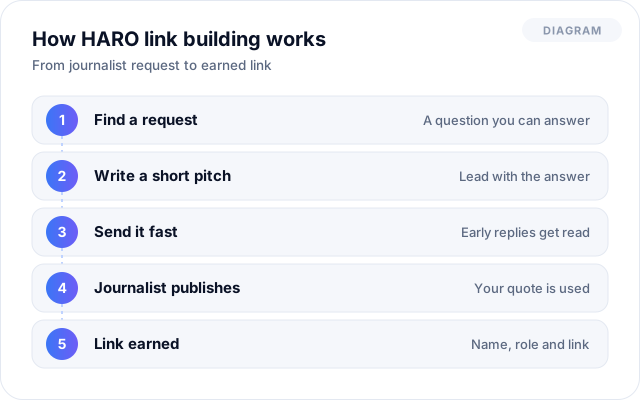
How does it work, step by step?
- 1
Find a request
Look for a question that matches what you really know.
- 2
Write a short pitch
Answer the question directly. Give one or two lines the journalist can quote.
- 3
Send it fast
Early replies get read first. Many requests close within hours.
- 4
Wait for the article
If your answer is used, the article goes live with your name and often a link.
See every step in detail in how HARO link building works.
Why are HARO backlinks so valuable?
- They come from real publications with real readers
- They are earned, not bought, so they are safe
- One strong link can lift the authority of your whole site
- Your name and brand appear next to your topic, which also helps AI search
One of our clients grew from 500 to 17,000 monthly visitors in nine months. See the cloud hosting case study.
What makes a pitch work?
- Answer the exact question
- Keep it short, usually under 200 words
- Share real experience, not general advice
- Say who you are and why you are qualified
- Do not sell your product
Our HARO pitch template gives you a structure to copy.
Who should use HARO link building?
HARO link building suits any business with a real expert who is willing to be quoted. That expert can be a founder, a director or a senior specialist. What matters is that they know their subject from experience.
- Software and technology companies
- Finance, mortgage and insurance professionals
- Real estate agents, investors and home buyers
- Health and wellness practitioners with credentials
- Lawyers, accountants and consultants
- Online store owners with deep product knowledge
It is less suitable for a business that cannot name a person. Journalists quote people, not company names. It also does not suit anyone who needs a large number of links in a few days.
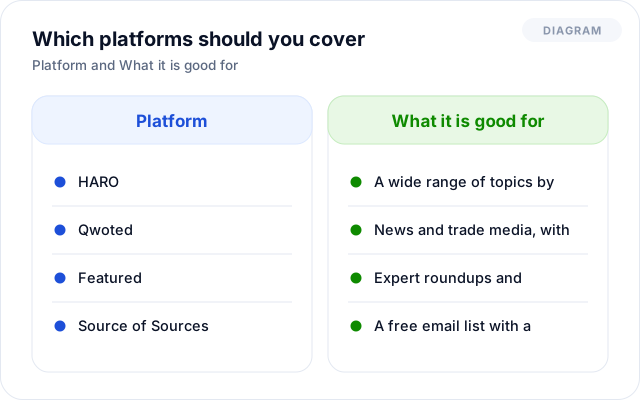
Which platforms should you cover?
In the past, HARO was the only place that mattered. That is no longer true. Requests are now spread across several services, and each one reaches different journalists.
| Platform | What it is good for |
|---|---|
| HARO | A wide range of topics by email |
| Qwoted | News and trade media, with verified reporters |
| Featured | Expert roundups and question and answer articles |
| Source of Sources | A free email list with a mix of requests |
| Help a B2B Writer | Business and software topics |
You do not need all of them on day one. Start with two, learn what works, then add more. Our guide to the best HARO alternatives compares them.
How do you choose which requests to answer?
Most requests will not be right for you. Choosing well is the most important skill in HARO link building. A simple test helps.
- 1
Is it your subject?
You should be able to answer from memory, without research.
- 2
Do you meet the requirements?
Some journalists want a specific job title, country or qualification.
- 3
Is the publication relevant?
A link from a site in your field is worth more.
- 4
Can you meet the deadline?
A late answer is usually a wasted answer.
If you answer no to any of these, skip the request. Sending fewer, stronger pitches gets better results than replying to everything.
What happens after you send a pitch?
Often, nothing for a while. Journalists rarely confirm that they received your reply. If they want to use it, some will email you with a follow-up question. Many will simply publish.
This is why tracking matters. Search for your name and your company every week. You may find articles you were never told about. Our guide on how to track HARO mentions explains a simple routine.
Sometimes you will be quoted without a link. That still has value, and you can politely ask for the link to be added.
What mistakes should beginners avoid?
- Replying to requests outside your expertise
- Writing long pitches that bury the answer
- Promoting your product in place of answering
- Using the same text for different requests
- Giving up after a few weeks without a result
The last one is the most common. HARO rewards patience. Many people stop just before their first placements arrive. Read more in HARO link building mistakes.
How does HARO fit with the rest of your SEO?
HARO builds authority for your whole website. It does not replace good content or a well built site. Think of it as one part of a wider plan.
- Your content answers what people search for
- Your site loads fast and works on phones
- HARO links tell search engines that others trust you
- Guest posts and other links support specific pages
When these work together, results come faster. Links pointing to a weak page will not help much. Links pointing to a strong page can lift it sharply.
How do HARO links help with AI search?
More people now ask AI tools for answers. These tools draw on sources they trust, and well known publications are high on that list.
When a respected publication quotes you by name, with your role and company, it creates a clear record that connects your brand to your topic. That is useful to a search engine and to an AI tool. Read how backlinks and brand mentions affect AI search.
Should you do it yourself or hire help?
You can do it yourself. It is free to try. The cost is time. You need to check requests every day and reply quickly.
A service does the daily work for you. It makes sense when your time is worth more than the fee. Compare options in our guide to HARO link building services.
Which articles are in this series?
Each article below covers one part of this topic in more detail.
- What Is HARO? History, Shutdown and Relaunch Explained
- Is HARO Still Active in 2026?
- How HARO Link Building Works, Step by Step
- Are HARO Backlinks Dofollow?
- HARO Success Rate: How Many Pitches Get Published?
- How Long Do HARO Links Take to Go Live?
- How to Sign Up for HARO as a Source
- HARO Query Categories and How to Filter Them
- HARO Rules: What Gets Sources Banned
- HARO Link Building Mistakes That Waste Pitches
- HARO vs Guest Posting: Which Builds Better Links?
- HARO vs Buying Links: Risk and Value Compared
- Is HARO Link Building Worth It in 2026?
- HARO for Startups: How New Companies Earn Trusted Links
- HARO for Small Businesses: A Simple Guide
- HARO for SEO Agencies: Adding Editorial Links for Clients
- How to Track HARO Mentions and Unlinked Placements
- Turning Unlinked HARO Mentions Into Links
Frequently asked questions
Is HARO link building free?
Replying to requests can be free. It takes time and practice, and many pitches are not chosen.
How long before I get a link?
Most of our clients receive their first placement within two to four weeks of starting.
Do I need to be famous to be quoted?
No. Journalists choose sources for the quality of the answer and their experience, not for fame.
Can one person represent a whole company?
Yes. Most companies put forward one or two named experts.
Is HARO link building safe?
Yes. The publication is not paid and the journalist decides freely, so the links are earned.