
This article is part of our editorial backlinks guide.
Why audit your backlinks?
- To see where your authority comes from
- To spot risky patterns
- To find lost or broken links you can recover
- To compare yourself with competitors
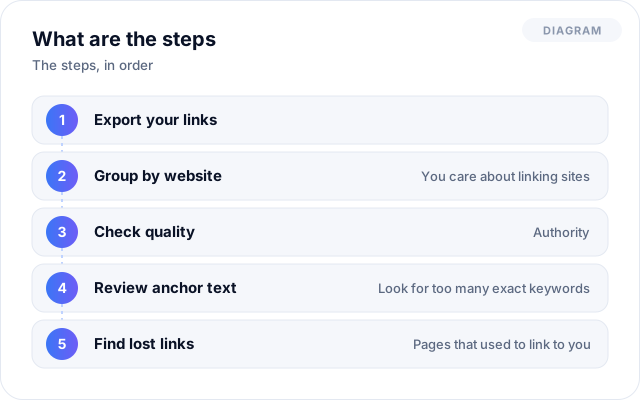
What are the steps?
- 1
Export your links
From Google Search Console and one SEO tool.
- 2
Group by website
You care about linking sites, not every link.
- 3
Check quality
Authority, relevance and real traffic.
- 4
Review anchor text
Look for too many exact keywords.
- 5
Find lost links
Pages that used to link to you.
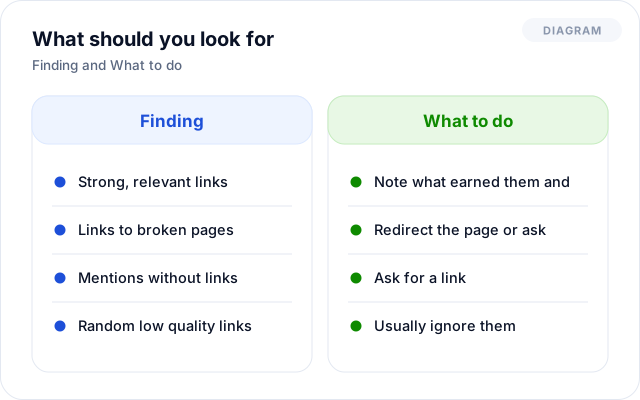
What should you look for?
| Finding | What to do |
|---|---|
| Strong, relevant links | Note what earned them and repeat it |
| Links to broken pages | Redirect the page or ask for an update |
| Mentions without links | Ask for a link |
| Random low quality links | Usually ignore them |
| A pattern of paid links | Consider removal or disavow |
Should you disavow links?
Rarely. Search engines ignore most junk links by themselves. Disavow is for clear cases, such as a manual action or a history of bought links.
What comes after the audit?
A plan. Most audits show the same thing: not enough links from trusted sites. The fix is to earn more of them.
See our HARO link building service for a steady source of editorial links.
What should you read next?
Frequently asked questions
How often should I audit?
Once or twice a year is enough for most sites.
Do I need a paid tool?
Search Console is free and a good start. A paid tool adds detail.