
This article is part of our complete guide to editorial backlinks.
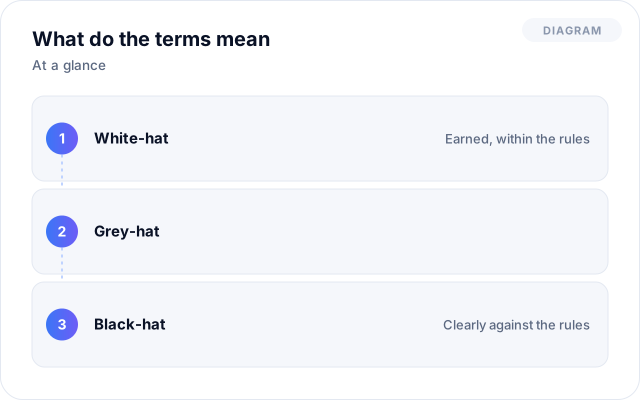
What do the terms mean?
| Type | Meaning | Example |
|---|---|---|
| White-hat | Earned, within the rules | A journalist quotes you |
| Grey-hat | Not clearly against the rules, but risky | Paid guest posts without labels |
| Black-hat | Clearly against the rules | Private blog networks, hacked links |
What counts as white-hat?
- Expert quotes in the press
- Links to useful guides, tools or data
- Guest articles on relevant sites, done in moderation
- Asking for a link where you are already mentioned
Where is the grey area?
Most grey-hat methods involve arranging a link in a way the search engine would not approve of if it knew. Paying for placements, swapping links at scale and using networks of related sites all sit here.
Why do people use grey-hat methods?
They are faster and more predictable. The cost comes later, if the links are discounted or the site is flagged.
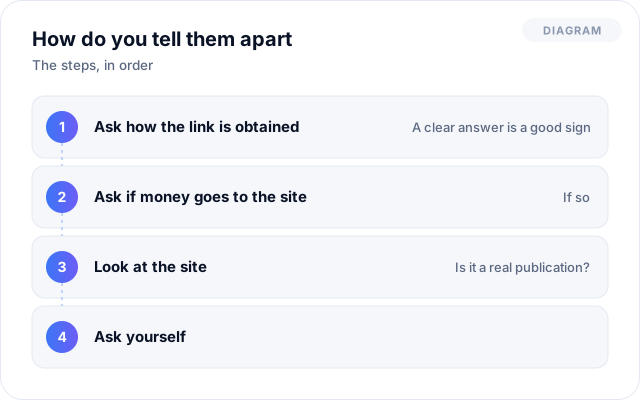
How do you tell them apart?
- 1
Ask how the link is obtained
A clear answer is a good sign.
- 2
Ask if money goes to the site
If so, is the link labelled?
- 3
Look at the site
Is it a real publication?
- 4
Ask yourself
Would you be happy to show this link to a customer?
What do we do?
Our core service is journalist outreach, which is white-hat. See our HARO link building service and the rules in Google's link spam policy.
What should you read next?
Frequently asked questions
Is guest posting white-hat?
On relevant sites, with useful articles and in moderation, yes.
Is white-hat slower?
Usually. The results last longer.