
This article is part of our complete guide to HARO link building.
What are the most common mistakes?
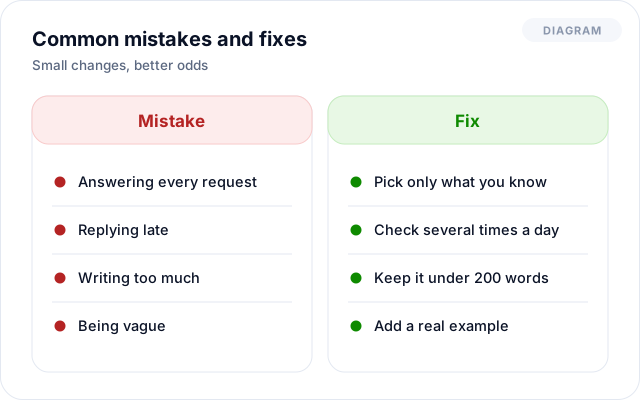
| Mistake | Fix |
|---|---|
| Answering every request | Pick only the ones you know |
| Replying late | Check requests several times a day |
| Writing too much | Keep it under 200 words |
| Being vague | Give a real example or number |
| Selling your product | Answer the question only |
| No credentials | State your role and experience |
Why is pitching off topic so harmful?
Journalists remember names. If you send irrelevant pitches, they may skip your next one without reading it.
Why do long pitches fail?
A journalist with fifty replies will not read five paragraphs. They scan for a clear answer and a usable quote. If they cannot find it in seconds, they move on.
What mistakes happen after the pitch?
- Chasing the journalist with reminders
- Not checking whether the article was published
- Ignoring mentions that have no link
- Giving up after two or three weeks
Learn to track HARO mentions so you do not miss results.
Mistake: answering everything
It feels productive to reply to as many requests as possible. It usually backfires. A journalist who sees your name on a weak reply may skip your next one.
The fix is simple: reply only when you could answer without looking anything up. If you have to research, you are not the expert for that request.
Mistake: writing a long introduction
Many pitches spend the first paragraph on the company. The journalist did not ask for that. They asked a question.
| Wasteful opening | Better opening |
|---|---|
| "We are a leading provider of innovative solutions..." | "The simplest fix is to reply within the hour." |
| "Thank you for the opportunity to contribute..." | "Short answer: pay the highest interest first." |
Put your answer first. Give your credentials in one line afterwards.
Mistake: no proof
Claims without evidence read like opinions anyone could have. Add one piece of proof to every pitch.
- A number from your own records
- A short real example
- A qualification or licence
- The length of your experience
Mistake: ignoring the result
People send a pitch and forget it. Weeks later an article appears and nobody notices, or the journalist quoted them without a link and they never ask.
Set aside ten minutes a week to search for your name and your company. Learn how to track HARO mentions and ask politely for missing links.
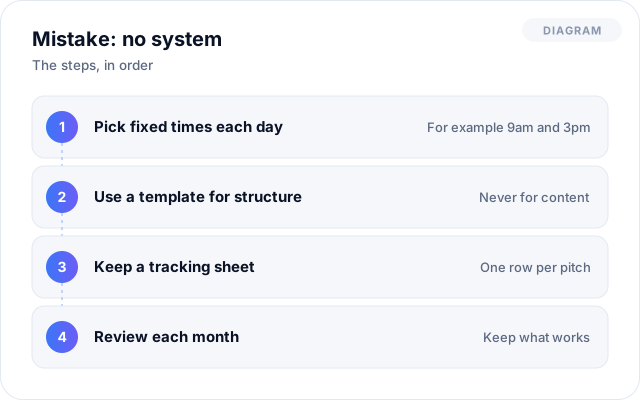
Mistake: no system
HARO punishes irregular effort. A burst of pitching for two weeks, followed by silence, gives you almost nothing.
- 1
Pick fixed times each day
For example 9am and 3pm.
- 2
Use a template for structure
Never for content.
- 3
Keep a tracking sheet
One row per pitch.
- 4
Review each month
Keep what works.
Mistake: giving up early
The most expensive mistake is stopping just before results arrive. A campaign that runs for three months almost always beats one that runs for three weeks.
If daily pitching does not fit your life, hand it to a team. Our HARO links service keeps going even when you are busy.
Mistake: using the same pitch for everything
It is tempting to build a stock reply and tweak the first line. Journalists can tell. They may have received three near-identical replies from three different people.
Use the structure of a template, but write the content fresh. Even two new sentences make it clearly yours.
Mistake: ignoring your website
If a journalist clicks your link and finds an unfinished page, you lose the benefit of the placement. Before you start, check that your site is live, clear and works on a phone.
- A clear homepage and about page
- Contact details
- Pages that load fast
- Content that supports what you said
How do you review your own work?
- 1
Read your last five pitches
Pick the weakest one.
- 2
Ask what was missing
Proof, speed, focus or clarity.
- 3
Rewrite it
As if you were answering today.
- 4
Apply the lesson
To the next pitch.
Mistake: giving advice outside your expertise
A request on a topic close to yours can be tempting. If you cannot support the answer from experience, a journalist or editor may catch it. Wrong advice in a published article can damage your reputation for a long time.
In regulated fields such as finance, health and law, this is also a professional risk. Reply only where you are fully qualified.
Mistake: forgetting that an editor reviews the article
- A long quote may be cut to one line
- Your best line should come first
- Claims you cannot support may be removed
- Your title and company are checked
Write with the editor in mind. A short, clear, accurate quote survives editing.
What is a simple checklist before you hit send?
- Does the first sentence answer the question?
- Is there one real example or number?
- Is it short enough to read on a phone?
- Are my name, role and company at the end?
- Have I removed anything that sounds like an advert?
Taking thirty seconds to run through these five checks prevents most of the mistakes in this guide.
What is the biggest mistake of all?
Stopping too soon. HARO works through steady effort over months. Many people quit just before results arrive.
If daily pitching is not realistic for you, our HARO links service keeps it going.
What should you read next?
Frequently asked questions
How many pitches should I send a week?
As many as you can answer well. Quality matters more than a target number.
Should I reply if I am only partly qualified?
No. Wait for a request that fits you properly.
What is the single biggest mistake?
Replying to requests you are not qualified to answer.
How do I recover after a bad pitch?
Move on. Send a stronger pitch to the next request.
How do I know if I am making a mistake?
Look at pitches that were not used and ask what a journalist would have wanted more of.