
This article is part of our full guide to HARO link building.
What counts as buying links?
Buying a link means paying a website owner to place a link to you, without it being labelled as an advert. Search engines say this breaks their rules.
Paying a team to do outreach for you is different. With HARO, the publication is not paid. The journalist chooses whether to quote you.
How do they compare?
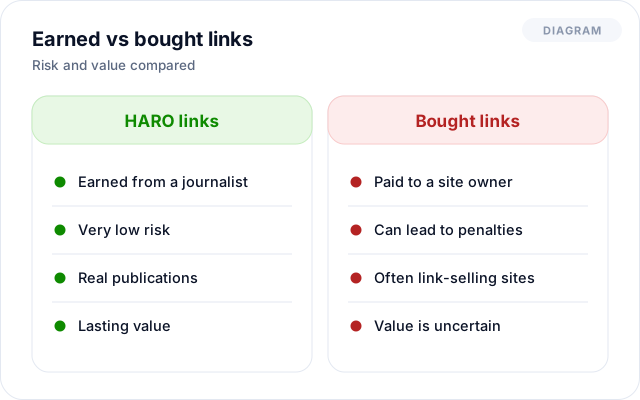
| HARO links | Bought links | |
|---|---|---|
| How obtained | Earned from a journalist | Paid to a site owner |
| Risk | Very low | Can lead to penalties |
| Typical site quality | Real publications | Often link selling sites |
| Speed | Weeks | Days |
| Lasting value | High | Uncertain |
What are the risks of buying links?
- Search engines may ignore the links, so the money is wasted
- A site can be penalised for a pattern of paid links
- Link selling sites often sell to anyone, including spam
- The link may be removed when the payment ends
Why do people still buy links?
It is fast and predictable. For a short time it can seem to work. The problem appears later, when the links are discounted or the site is flagged.
What does Google say about paid links?
Google has long said that links bought to influence rankings go against its guidelines. Paid links are allowed only when they are labelled, so that they are not counted as editorial votes.
In practice, this means unlabelled paid links are a risk. The risk is not always a penalty. Often the links are simply ignored, which wastes the money.
How do you recognise a paid link offer?
- A price list per link, by site
- Promises of a fixed authority score
- Placement in days, not weeks
- No named journalist or author
- An offer to use the same site for many clients
A real editorial link cannot be ordered from a menu. If you can buy it, it is an advert.
What is the long term cost?
| Cost | Earned links | Bought links |
|---|---|---|
| Upfront | Time or a service fee | A fee per link |
| Risk of losing value | Very low | High if the site is flagged |
| Cleanup later | None | Sometimes needed |
| Trust with customers | Builds it | Adds nothing |
The cheapest option on day one can be the most expensive over a few years.
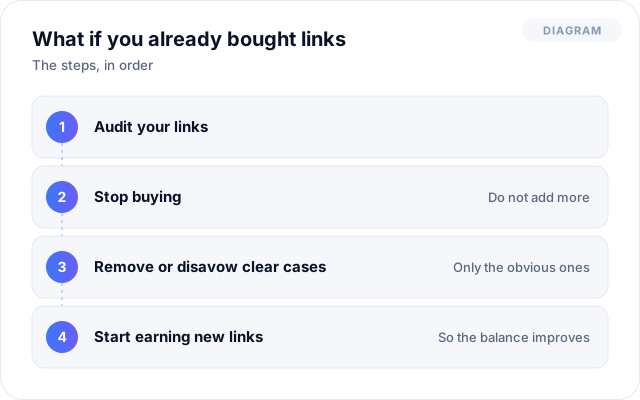
What if you already bought links?
- 1
Audit your links
List what you have and where it came from.
- 2
Stop buying
Do not add more.
- 3
Remove or disavow clear cases
Only the obvious ones.
- 4
Start earning new links
So the balance improves.
See our guide to how to audit your backlinks.
Is paying for a HARO service the same thing?
No. When you pay a service, the money covers research, writing, outreach and reporting. The publication receives nothing, and the journalist chooses freely whether to quote you.
A good service says so openly, shows live examples and lets you approve quotes. Ours is described on the HARO link building service page.
Why do paid links tempt people?
They are fast, predictable and easy to buy. A menu of sites with prices is simpler than waiting for a journalist.
But a link you can buy is a link anyone can buy, including your competitors and spammers. That is why search engines give them less trust.
What does a safe plan look like?
- Earn links through expert quotes and useful content
- Use labelled sponsored placements only as advertising
- Keep your anchor text natural
- Review your links once or twice a year
What are the signs your link profile is healthy?
It contains links from many different websites, in varied wording, from sites in or near your field. It grows steadily. It does not suddenly jump after a purchase.
Read Google's link spam policy for more on the rules.
What do search engine guidelines say about links in general?
The principle is simple. Links should be a natural result of people finding your content useful. Anything done mainly to influence rankings is at risk.
- Natural links: a writer cites you because you helped them
- Arranged links: you agree a link in return for something
- Paid links: money is exchanged for the link
Only the first kind is entirely safe.
How should you talk to a provider about this?
- 1
Ask where the links come from
Specific publications, not a "network".
- 2
Ask if the site is paid
Any answer other than no is a flag.
- 3
Ask for live examples
Check them yourself.
- 4
Ask for the guarantee in writing
And read it.
What is the safer path?
Earn links by being useful. It takes longer, but the result lasts. See our guide to editorial backlinks.
People search for ways to buy HARO links. What you are really buying is the work of earning them. That is what our HARO link building packages cover.
What should you read next?
If you want one team for all of your link building, our sister site offers a complete authority link building service.
Frequently asked questions
Is paying a HARO service the same as buying links?
No. You pay for outreach work. The publication receives nothing and decides freely.
Are sponsored links ever acceptable?
Yes, when they are clearly labelled as sponsored. They are adverts, not editorial votes.
Is it ever worth buying links?
Labelled sponsored placements are fine as advertising. Do not count them as editorial links.
How can I tell if a seller is honest?
Ask how the links are obtained and ask for live examples.
Can paid links ever help rankings?
Sometimes briefly. The risk and the uncertainty make them a poor long term choice.