
This article is part of our HARO link building guide.
What categories has HARO used?
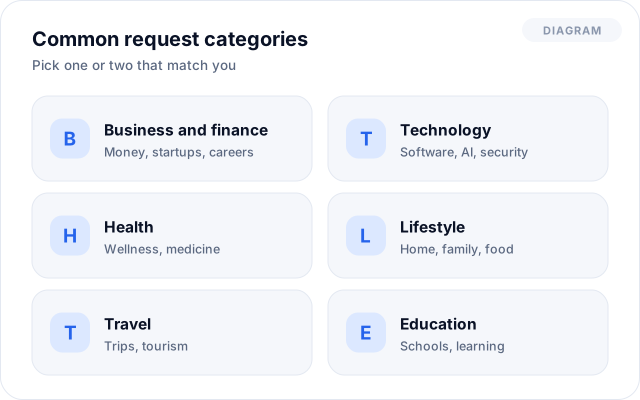
HARO has grouped requests under broad headings such as these.
- Business and finance
- Technology
- Health and healthcare
- Lifestyle and fitness
- Travel
- Education
- Entertainment and media
- General
The list can change. Check the current options when you sign up.
Which categories should you choose?
Choose the one or two that match your real expertise. A finance expert should not subscribe to travel just to see more requests.
More categories mean more emails to read, and more temptation to send weak pitches.
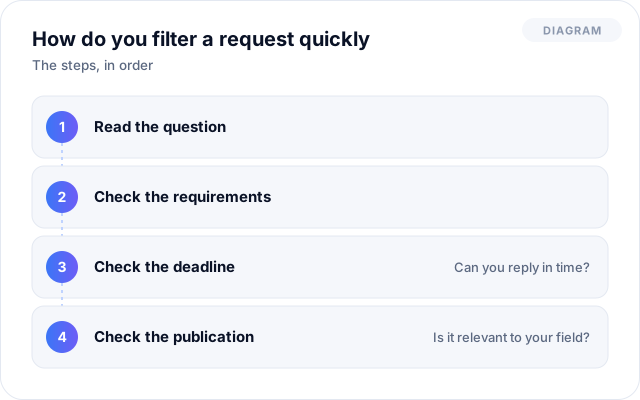
How do you filter a request quickly?
- 1
Read the question
Can you answer it from real experience?
- 2
Check the requirements
Does the journalist want a specific job title or location?
- 3
Check the deadline
Can you reply in time?
- 4
Check the publication
Is it relevant to your field?
If any answer is no, skip it.
What about anonymous requests?
Some requests do not name the publication. They can still be worth answering, but give priority to named publications you recognise.
Why do categories exist?
Journalists post requests on every subject imaginable. Without sorting, you would have to read hundreds of requests to find a handful that fit. Categories narrow the list to topics you chose.
They are a rough filter, not a precise one. A request in the business category can be about anything from tax to team management, so you still need to read each one carefully.
How do you choose your categories?
- 1
List your real expertise
Write down what you could talk about for ten minutes.
- 2
Match each topic to a category
Most will fall into one or two.
- 3
Pick those categories only
Resist adding more.
- 4
Review after a month
Remove ones that bring noise.
A narrow choice means fewer emails and a higher share worth answering.
What kinds of requests appear in each category?
| Category | Typical requests |
|---|---|
| Business and finance | Saving, pricing, hiring, tax, startups |
| Technology | AI tools, security, software, gadgets |
| Health | Sleep, nutrition, fitness, wellbeing |
| Lifestyle | Home, family, food, fashion |
| Travel | Trip planning, destinations, costs |
| Education | Study, schools, careers |
How do you read a request quickly?
Scan in this order: the summary, the requirements, the deadline and then the question. If the requirements rule you out, stop.
- Job title or licence the journalist needs
- Location of the source
- Experience level asked for
- Whether the reply must be short or can be long
Skipping the requirements is the most common reason replies are ignored.
Should you answer requests that cross categories?
Sometimes. A founder of a health app can answer a technology request and a health request. The test is whether you can give a specific, experienced answer, not what the category label says.
Never reply just because you could write something plausible. Journalists notice.
How do categories connect to your industry strategy?
Your industry decides which categories matter most. Finance firms live in business and finance. Software firms need technology and business. See our guide to link building by industry.
We handle the filtering for clients in our HARO link building service, so only the best requests are answered.
How do you handle requests with no clear category?
Some requests are labelled "general". They can be about anything. Read them quickly and only answer if you have real experience.
These requests often come from smaller publications, which can still be valuable. A link from a relevant small site is better than none.
How do you keep your inbox under control?
- Use filters to label request emails
- Read them at set times, not all day
- Archive requests you skip
- Unsubscribe from categories that bring nothing
What do beginners often get wrong?
They choose too many categories, reply to the wrong ones and burn out in a week. Start narrow. You can always add more later.
Read HARO sign up for a good way to start.
How do you build a topic list that works?
Write down ten things you could talk about without preparation. Group them into three themes. Those themes become your categories and your keywords.
| Example expert | Themes |
|---|---|
| Mortgage broker | Rates, first time buyers, refinancing |
| Software founder | Hiring, AI tools, pricing |
| Dentist | Oral health, children, costs |
Narrow themes mean strong matches.
How do you decide when to add a category?
- You keep seeing requests you could answer outside your categories
- Your current categories bring fewer than two good requests a week
- Your business has expanded into a new area
Add one at a time and review after two weeks. If it brings noise, remove it.
How do categories help you plan your week?
Once your categories are fixed, you know what to expect. You can set aside a regular time to read requests and a regular time to write. That routine matters more than any single pitch.
- Morning: read new requests in your categories
- Midday: write and send one strong reply
- End of week: check which categories brought the best matches
- Monthly: adjust your choices based on what you learned
Over a few months you will see which categories reward you and which only add noise.
How do categories relate to industries?
Your industry decides which categories matter. See our guide to link building by industry.
Our HARO link building team filters requests for each client every day.
What should you read next?
Frequently asked questions
Can I change my categories later?
Yes. Adjust them as you learn which ones bring useful requests.
Should I answer requests outside my field?
No. Journalists notice, and it wastes your time.
Can I change categories later?
Yes. Adjust them whenever your focus changes.
Do other platforms use the same categories?
Not exactly. Each platform has its own system.
How many categories should I pick?
One or two to start. Add more only if you have the time to answer the extra requests.