
This article is part of our full guide to HARO link building.
What are the main rules?
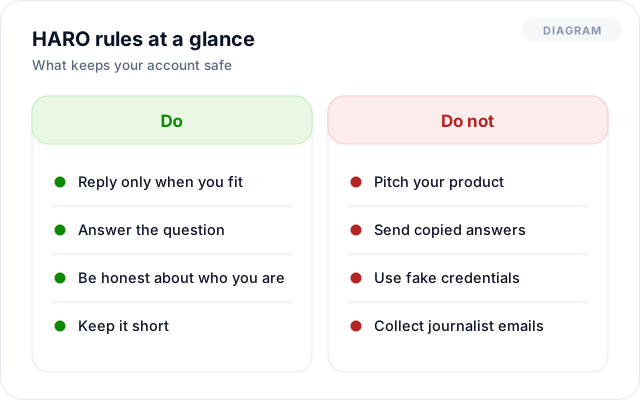
- Reply only to requests that match your expertise
- Do not pitch your product in place of an answer
- Do not add journalists to mailing lists
- Do not share or sell requests
- Be honest about who you are
Always read the current rules on the official site. They can change.
What gets sources banned?
| Behaviour | Why it is a problem |
|---|---|
| Off-topic pitches | Wastes the journalist's time |
| Fake names or credentials | Puts the publication at risk |
| Copied or mass produced answers | Adds no value |
| Harvesting emails | Breaks trust and privacy |
| Repeated follow-ups | Seen as harassment |
What about AI-written answers?
Journalists are quick to spot generic answers written by AI. Many now reject them, and some platforms act against accounts that send them in bulk.
Using a tool to tidy your wording is one thing. Letting it invent your expertise is another.
Can someone pitch on your behalf?
Yes, if it is done honestly. The expert is real, the knowledge is theirs, and they approve what is sent. That is how PR has always worked.
It is how our HARO link building service operates.
Why do these rules exist?
Journalists use these services to save time. When replies are irrelevant, copied or false, the service stops being useful to them and they leave. Rules protect the quality of the whole system.
Every rule exists because someone abused it. Understanding the reason helps you follow the spirit, not only the letter.
What rules do sources usually have to follow?
| Rule | Why it matters |
|---|---|
| Reply only when qualified | Stops wasted time |
| Answer the question asked | Journalists need answers, not adverts |
| No harvesting of emails | Protects journalists from spam |
| Be truthful about your identity | Protects publications from false sources |
| No selling or sharing of requests | Keeps the service fair |
Always read the current terms on the official site, because they change.
What does a warning or a ban look like?
Platforms usually start with a warning or a reduced reply limit. Repeated or serious breaches can lead to removal. Some journalists also keep their own private lists of sources they will never use again.
That last point matters more than the official ban. A journalist who has been burned by one of your replies may delete every future one without reading.
How should you behave after you are quoted?
- Thank the journalist briefly
- Share the article, but do not tag them in a way that feels pushy
- Do not ask for changes unless there is a real error
- Do not ask for a link to be moved or reworded
A relationship is built on small acts of good manners. They add up.
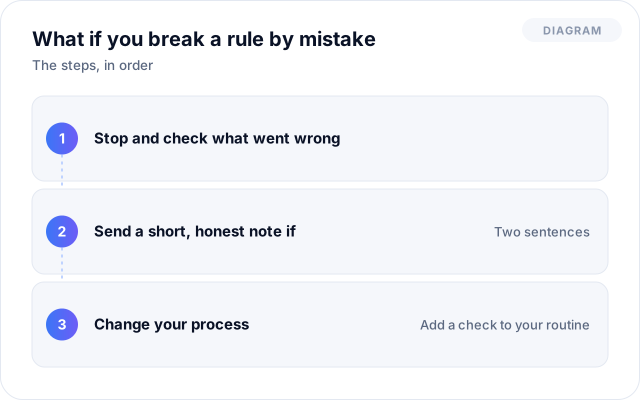
What if you break a rule by mistake?
- 1
Stop and check what went wrong
Was it a misread requirement or a late reply?
- 2
Send a short, honest note if a journalist was affected
Two sentences, no excuses.
- 3
Change your process
Add a check to your routine.
Honest mistakes are forgiven far more often than careless ones.
How do agencies stay within the rules?
A responsible service uses real, named experts who approve what is sent. It does not mass-produce replies or invent credentials. That is how our HARO link building service works.
What are the rules for AI-written replies?
Rules about AI differ by platform, and they are changing. Many journalists say they will ignore replies that look machine written, and some platforms act against accounts that send them in bulk.
The safe approach is to write from your own experience, and to use AI only for light editing. See can you use AI to write HARO pitches.
What should you do if a journalist asks you to remove a quote?
Do what they ask, calmly. Reasons can include legal advice, a change of story or a mistake. Arguing never helps.
How do you keep records?
- Save each pitch you send
- Keep the original request
- Note any messages with the journalist
- Record the published result
If a question ever arises, a record protects you.
What are the rules for journalists?
Rules apply on both sides. Journalists are usually expected to post genuine requests, to say who they are and to treat sources fairly.
- Requests must be for real stories
- Journalists should not use sources' details for marketing
- Credit and links should be handled in line with the publication's policy
- Sources should be told if a quote cannot be used, where practical
In practice, many journalists do not follow up. Silence is not a breach of the rules.
How do you check the current terms?
Rules change. Before you start, read the terms on the platform's own website. Look for sections on acceptable use, source obligations and what happens when rules are broken.
Check them again every few months. It takes five minutes and protects your account.
What is the simplest way to stay safe?
Treat every journalist as a busy person doing you a favour by reading your reply. Be useful, be honest and be brief.
- Reply only when you are truly qualified
- Answer the question that was asked
- Never invent credentials or facts
- Respect deadlines and instructions
If you follow these four habits, you will rarely break a rule and your reputation will grow.
How do you build a good reputation?
- Be useful every time
- Reply fast and keep to the brief
- Deliver extra detail when asked
- Thank the journalist and move on
What should you read next?
Frequently asked questions
Can I use a pen name?
No. Journalists need a real, verifiable person.
What if I make a mistake in a pitch?
Send a short correction. Honesty protects your reputation.
Is it against the rules to hire help?
Not if the expert is real and approves the quotes. This is common practice in PR.
Can I reply to the same request twice?
Send one strong reply. Duplicates are annoying.
Can I be banned without warning?
It can happen for serious breaches. Most platforms warn first.