
This article is part of our full guide to HARO link building.
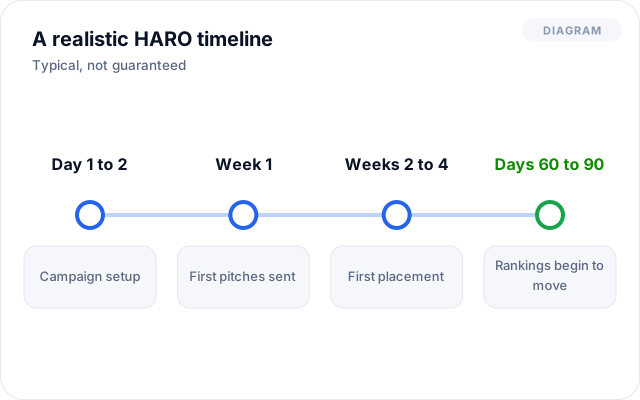
What is the usual timeline?
| Stage | Typical time |
|---|---|
| Campaign setup | 24 to 48 hours |
| First pitches sent | First week |
| First placement goes live | Two to four weeks |
| Rankings begin to move | 60 to 90 days after placement |
These are typical for our clients. Your results can be faster or slower.
Why do some articles take so long?
- The journalist may be working on a long feature
- Editors review and schedule articles
- Some stories are held for a season or an event
- A few are never published at all
Which industries move fastest?
Marketing, software and general business topics often move quickly. Finance and health can take longer, because journalists check credentials more carefully.
When will rankings change?
Search engines have to find the new link and reassess your site. That takes time. Improvements often begin to show within 60 to 90 days of a link going live.
One link rarely changes much alone. Steady placements over several months do.
What happens in week one?
The first week is mostly preparation. You or your provider set up profiles, agree topics and write the first pitches.
- Profiles are completed on each platform
- A short bio and headshot are approved
- Two or three topics are chosen as the focus
- The first requests are answered, usually within days
Nothing is published yet. Do not judge the campaign by this week.
What happens in weeks two to four?
This is when the first placements usually appear. Some are quick, such as a short blog article that goes live within days. Others take longer.
It is common to see one or two placements in this period, then more as the pitching continues. A slow first month does not mean the campaign is failing.
What happens in the second and third month?
By now the pitching routine is steady. More articles go live, and the earliest links have had time to be found by search engines.
| Month | What you usually see |
|---|---|
| Month 1 | Setup, first pitches, first placements |
| Month 2 | More placements and regular reports |
| Month 3 | Most of a package delivered, early ranking movement |
Read what to expect in your first 30, 60 and 90 days for a fuller picture.
Why do rankings move later than links?
A link has to be found, assessed and added to the picture a search engine has of your site. That takes time. It also depends on how strong your page already is and how competitive your keywords are.
Links to a strong page move rankings faster than links to a weak page. This is one more reason to keep your content in good shape while you build links.
What can delay a placement?
- Journalists working on long feature articles
- Seasonal stories that wait for the right month
- Editorial approval and legal checks
- Slow replies when more detail was requested
- Your own delay in approving a quote
You cannot control all of these, but the last two are in your hands. Fast approvals keep campaigns moving.
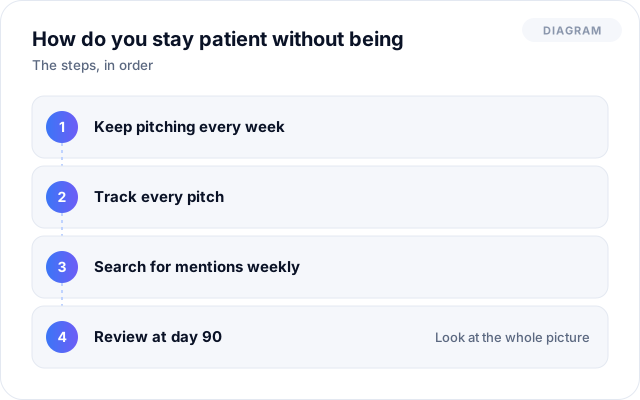
How do you stay patient without being passive?
- 1
Keep pitching every week
Gaps in outreach become gaps in results.
- 2
Track every pitch
So you know what is waiting to be published.
- 3
Search for mentions weekly
Many articles appear without notice.
- 4
Review at day 90
Look at the whole picture, not one week.
How do different platforms affect speed?
| Platform | Typical speed |
|---|---|
| Featured | Often quicker, short answers |
| HARO | Varies, many articles take weeks |
| Qwoted | Varies by reporter and outlet |
Using several platforms evens out the waiting.
How should you plan around the timeline?
- Start link building before you need the results
- Do not launch a big campaign with no links behind it
- Plan content updates for the third month, when links begin to count
- Review results at day 90, not day 14
What is a sign that things are on track?
A steady flow of pitches, one or two placements in the first month and a growing list of linking websites by month three. If none of these is happening, ask what has been sent and review the topics.
Our HARO link building reports show exactly where each pitch stands.
What should you do while you wait?
Waiting does not mean doing nothing. The weeks between pitching and publication are a good time to improve the pages you want links to.
- Update the content on your most important pages
- Fix slow loading and mobile problems
- Add a clear author and expert page
- Collect a few figures or examples for future pitches
When links arrive, a strong page converts them into better rankings faster than a weak one.
How do you report progress to a manager or client?
Report what is known, not what is hoped for. Show pitches sent, placements live and pitches still pending. Explain that rankings lag behind links by weeks.
| Month | What to report |
|---|---|
| 1 | Setup done, pitches sent, first placements |
| 2 | Total placements, link types, early traffic |
| 3 | Rankings, organic visits and next steps |
How can you speed things up?
- Reply to requests quickly
- Have your profile, bio and headshot ready
- Approve drafts fast if someone writes for you
- Keep pitching every week
See how our HARO link building process keeps campaigns moving.
What should you read next?
Frequently asked questions
Will I be told when my article is published?
Not always. Journalists often do not send a notice. We track placements and report them.
Can a link be removed later?
Yes. Publications can edit or remove articles. It is uncommon, but it happens.
Is two months with no links a bad sign?
It can be normal in slow niches. Ask what has been pitched and review the topics.
Do links lose value over time?
Links from stable publications usually keep their value. Removed articles are the exception.
What is a normal number of placements in the first month?
One or two is common. Some campaigns see more, some fewer.