
This article is part of our HARO link building guide.
Is there a standard success rate?
No. It changes with your industry, your expertise and how well you choose requests. Anyone who quotes one fixed number is guessing.
What is certain is that many pitches go unused. A journalist may get dozens of replies and quote two or three.
What affects your odds?
| Factor | Why it matters |
|---|---|
| Relevance | Off-topic pitches are deleted at once |
| Speed | Early replies are read first |
| Credentials | Journalists need a qualified source |
| Clarity | A ready quote saves the journalist time |
| Competition | Popular topics get more replies |
How can you improve your rate?
- Answer fewer requests, and only ones you truly know
- Reply within a few hours
- Lead with the answer
- Use a real example from your work
- Keep it short
Our HARO pitch template helps with structure.
Why is counting pitches the wrong measure?
Sending 100 weak pitches is worse than sending 20 strong ones. What matters is the number and quality of links you earn.
This is why our HARO link building service guarantees delivered links, not pitches.
Why do most pitches fail?
It helps to see the reasons plainly. Most failures have nothing to do with how good you are. They come from how journalists work.
- Journalists receive many more replies than they need
- The deadline passes before your reply is read
- The story changes direction and the quote is no longer needed
- An editor cuts the section where you would have appeared
- The journalist picks someone with a stronger credential
Knowing this takes the sting out of silence. A pitch that is not used is the normal outcome, not a personal verdict.
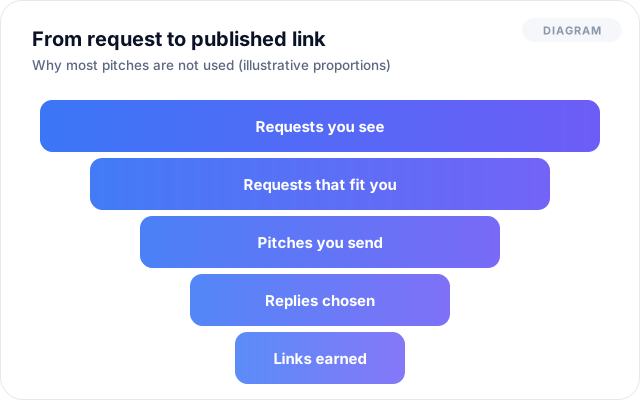
What does the pitching funnel look like?
Think of it as a series of narrowing steps. Each step removes most of what is above it.
| Step | What happens |
|---|---|
| Requests you see | Dozens arrive every day |
| Requests that fit you | A small share match your expertise |
| Pitches you send | You choose the best of those |
| Replies chosen | The journalist uses a few |
| Links earned | Some of the quotes carry a link |
The numbers vary by field and by person, which is why we do not quote a single success rate.
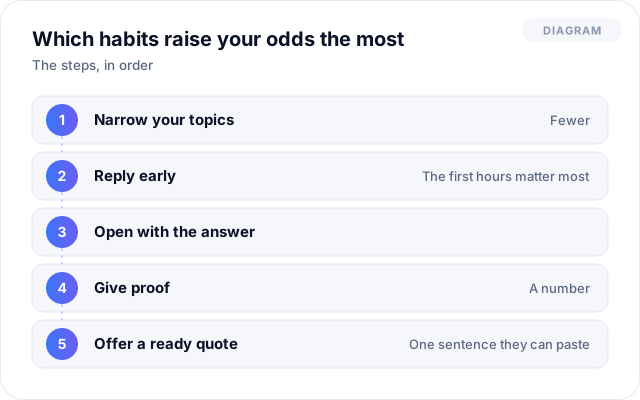
Which habits raise your odds the most?
- 1
Narrow your topics
Fewer, sharper subjects mean better matches.
- 2
Reply early
The first hours matter most.
- 3
Open with the answer
Do not make the journalist hunt for it.
- 4
Give proof
A number, a case or a qualification.
- 5
Offer a ready quote
One sentence they can paste.
None of these needs special skill. They need discipline. Applying all five to every pitch makes a visible difference within a few weeks.
How should you track your own rate?
Keep a simple log. For each pitch record the date, the topic, the platform and the result. After thirty pitches, patterns appear.
- Which topics get chosen most often
- Which platforms bring you the best replies
- How fast you replied when you were chosen
- Which pitches were longest and which were shortest
Most people find their chosen pitches are shorter, faster and more specific. That is a useful rule to follow from then on.
Is a paid plan worth it for a better rate?
A paid plan may give you more pitches or earlier access to requests. It cannot make a weak pitch stronger. Upgrade only when you regularly run out of pitches and your replies are being chosen.
If your pitches are not being chosen, fix the pitches first. See how to pitch journalists.
How do guaranteed packages deal with this?
When you buy a package from us, you pay for delivered links, not for pitches. We carry the risk that some pitches will fail. That is why the price is per link and why our HARO link building service refunds the difference if we fall short.
How does industry change your chances?
| Industry | What affects your odds |
|---|---|
| Software and marketing | Many requests, many competing replies |
| Finance | Credentials matter a great deal |
| Health | Journalists want qualified experts |
| Home and lifestyle | Practical tips are welcome |
| Niche trades | Fewer requests, less competition |
A narrow niche can mean fewer requests but better odds on each one.
What should you do after a pitch is not used?
- Do not follow up, unless asked
- Look at the published article if one appears and see who was chosen
- Note what they had that you did not
- Move on to the next request
What mindset helps you stay consistent?
Treat each pitch as practice. You will send many that never appear. The ones that do will outweigh the rest.
People who last in HARO accept silence as normal and keep their eyes on the monthly total of links earned.
What does a healthy pitching month look like?
A healthy month is not measured by how many pitches were used. It is measured by how steady and careful your effort was.
- You checked requests every working day
- You replied only to requests that truly fit you
- Every reply gave a clear answer and a quotable line
- You logged each pitch and checked for new mentions
- You earned at least one placement, or learned why not
If you can tick most of these, your success rate will improve with time, even if some months are quiet.
How long before results show?
Articles are not published the day you pitch. Some appear in days, others in weeks. See how long HARO links take.
What should you read next?
Frequently asked questions
Is a low success rate a sign I am doing it wrong?
Not always. Even expert sources are passed over often. Look at the trend over a few months.
Does paying for a platform raise my success rate?
Paid plans may let you send more pitches. They do not make a weak pitch stronger.
Should I be worried if only a few pitches are used?
No. Judge success over several months and by the quality of the links.
Does a longer pitch raise my chances?
Rarely. Short, specific pitches are chosen more often.