
This article is part of our full guide to HARO link building.
Step 1: Set up your expert profile
Journalists check who you are before they quote you. Use your real name, job title, company and a short bio. Add a clear photo.
A complete profile builds trust. An empty one gets skipped.
Step 2: Find the right requests
Requests arrive every day. Most will not fit you. Pick only the ones where you have real knowledge.
Answering everything is a mistake. It wastes time and can get you marked as a spammer.
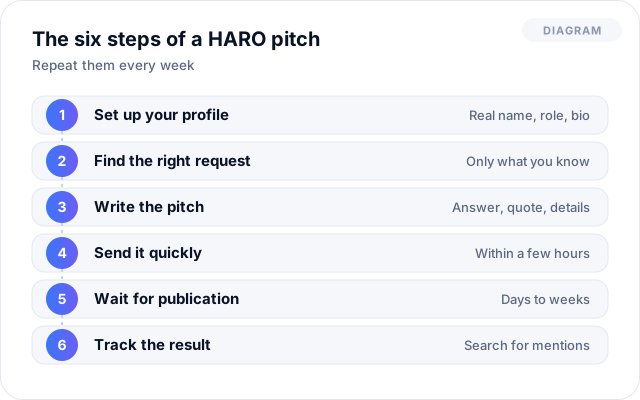
Step 3: Write the pitch
- Open with one line on who you are
- Answer the question in two or three short paragraphs
- Include one sentence that works as a quote
- End with your name, title, company and website
Use our HARO pitch template to save time.
Step 4: Send it quickly
Journalists work to deadlines. Many pick their sources from the first replies they read. Try to reply within a few hours.
Step 5: Follow up only if asked
If the journalist wants more detail or a headshot, send it fast. Do not chase them with reminder emails. That hurts your chances next time.
Step 6: Track the result
Journalists do not always tell you when an article is published. Search for your name and brand to find new mentions.
Sometimes you are named without a link. You can politely ask for one. See our brand mention link building page.
What does a journalist request look like?
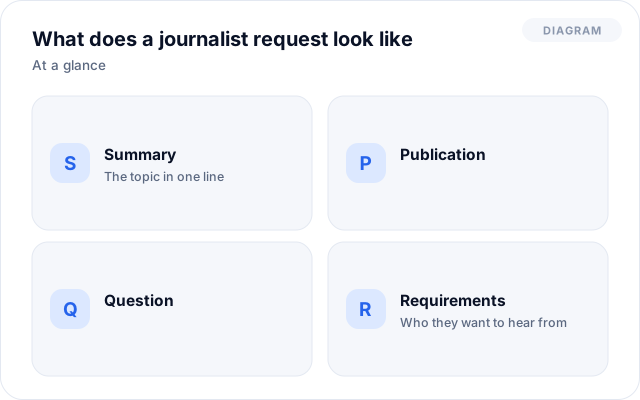
Every request has the same basic parts. Knowing how to read one quickly saves a great deal of time.
| Part | What it tells you |
|---|---|
| Summary | The topic in one line |
| Publication | Where the article will appear, if shared |
| Question | Exactly what the journalist wants to know |
| Requirements | Who they want to hear from |
| Deadline | The last moment to reply |
Read the requirements carefully. If the journalist asks for a licensed professional and you are not one, do not reply. They will not use you, and you may harm your reputation.
How do you decide what to say?
The best pitches come from experience, not research. Ask yourself what you have seen, done or learned that answers this question.
- A problem you solved and how
- A mistake you made and what it taught you
- A pattern you notice among your customers
- A number from your own business
- An opinion you hold that others in your field do not
Any one of these makes a stronger pitch than general advice. Journalists can find general advice anywhere.
What does the journalist do with your pitch?
A journalist may receive dozens of replies. They skim each one for a usable answer. If yours is clear and relevant, they copy the quote into their draft.
Later, an editor reviews the article. Quotes can be shortened or cut at this stage. That is why a short, self-contained quote is safer than a long one. It survives editing.
When the article is published, your name, role and company usually appear next to the quote. The link is added by the journalist or the editor, following the rules of the publication.
How long does the whole process take?
| Stage | Typical time |
|---|---|
| Finding and choosing a request | A few minutes |
| Writing the pitch | 15 to 30 minutes |
| Waiting for publication | Days to several weeks |
| Link being counted by search engines | Weeks after publication |
The writing is quick. The waiting is slow. See how long HARO links take to go live.
What tools do you need?
Very few. A work email address, accounts on the request platforms, a document with your bio and a place to store your headshot online.
A simple spreadsheet is useful for tracking. Record the date, the request, the publication and the outcome. After a few months it shows you which topics and platforms work best for you.
How can a team share the work?
In many companies the expert is too busy to pitch every day. A common setup splits the work.
- One person monitors requests and picks the good ones
- A writer drafts the answer from the expert's knowledge
- The expert reads and approves the quote
- Someone tracks published articles
This is also how a service works. The expert only spends a few minutes approving each quote.
How do you handle a request with a very short deadline?
Some requests close within two or three hours. Decide quickly whether it is worth it.
- If you can answer in ten minutes, do it
- If you need to research, skip it
- Send a short, clear answer, not a long one
- Do not apologise for a short reply
A fast, good answer beats a slow, perfect one.
What if a journalist asks a follow-up question?
It is a good sign. It usually means you are being considered. Reply quickly and answer exactly what was asked.
Keep your tone calm and professional. Do not take the chance to promote your company. Offer any supporting detail the journalist asks for, such as a headshot or a figure, and stop there.
How do you improve week by week?
| Week | Focus |
|---|---|
| 1 to 2 | Learn the format and send a few pitches |
| 3 to 4 | Tighten your answers and reply faster |
| 5 to 8 | Find the topics that get chosen |
| 9 and on | Do more of what works |
Small habits add up. After two months, most people reply faster, write shorter pitches and choose better requests.
When should you ask for help?
If you find yourself missing requests, running late on replies or losing steam after a few weeks, it may be time for support. A service can keep a campaign going while you focus on your business.
See our HARO link building packages.
How many pitches turn into links?
Not all of them. Journalists receive many replies and use only a few. That is normal.
This is why steady effort wins. Our HARO backlinks packages guarantee a number of delivered links, not a number of pitches.
What should you read next?
Frequently asked questions
How long does one pitch take?
A good pitch takes 15 to 30 minutes once you know your subject and have a template.
Can I use the same pitch twice?
No. Each request is different. Copied answers are easy to spot and are ignored.
Do I need to send a headshot with every pitch?
Include a link to one. Do not attach files unless asked.
What if the journalist does not name the publication?
You can still reply. Give priority to named publications you recognise.
Will the journalist tell me if I am not chosen?
Almost never. Silence is normal.