
This article is part of our complete guide to HARO link building.
What is the difference?
| Type | What it tells search engines |
|---|---|
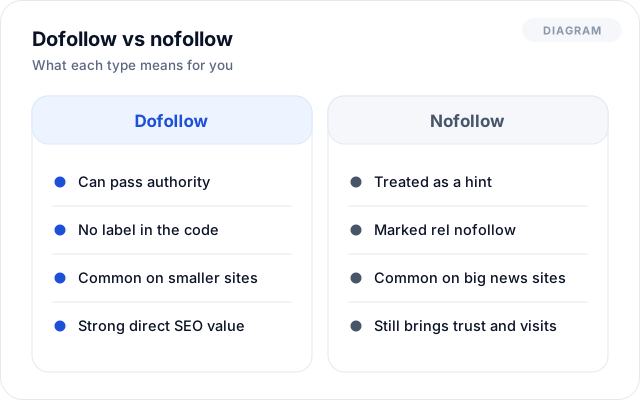
| Dofollow | This link can pass authority to the linked site |
| Nofollow | Treat this link as a hint, not a full vote |
| Sponsored | This link was paid for |
So are HARO links dofollow?
It depends on the site that publishes the article. Each publication has its own policy. Some give normal dofollow links to sources. Others mark every outside link as nofollow.
You cannot choose. A journalist cannot usually choose either. It is set by the publication.
Why do some big sites use nofollow?
Large publications get asked for links all day. Marking all outside links as nofollow is a simple way to stop people abusing them. It is not a judgement about you.
Are nofollow links still worth having?
- Search engines treat nofollow as a hint and may still take it into account
- Readers still click the link and visit your site
- Your brand is named in a publication people trust
- AI search tools read the mention whether the link is followed or not
- A natural link profile includes both types
How do you check a link?
Right-click the link in the article and choose Inspect. Look for rel="nofollow" in the code. If it is not there, the link is dofollow.
We report the link type for every placement in our HARO backlinks service.
Why does the link type matter?
Search engines use links to judge which sites can be trusted. A normal link, with no label, can pass some of that trust to the site it points to. A nofollow link tells search engines to treat it as a hint instead of a full vote.
This is why many SEO teams count dofollow links when they report results. The count is useful, but it can also mislead. A site with fifty weak dofollow links is not better off than a site with five strong nofollow mentions in respected publications.
What policies do publications follow?
There is no single rule. Each publication decides for itself, and policies change over time.
| Type of publication | Common policy |
|---|---|
| Large news and business sites | Often nofollow for all outside links |
| Trade magazines and niche sites | Often normal links for sources |
| Company blogs | Usually normal links to quoted experts |
| Content syndicated from partners | Varies, and may differ from the original |
The same journalist can write for two publications and get two different link policies. That is out of their hands.
What does the data from our placements show?
We do not publish a percentage, because a small sample would be misleading. What we see is a mix. Some placements carry normal links. Others carry nofollow. A few name the company without any link at all.
That mix is healthy. A link profile made up only of dofollow links looks unnatural. Real websites earn links of every type, and search engines expect to see that.
What other value does a nofollow mention bring?
- Readers click through and visit your site
- Your brand appears next to a respected name
- Other writers who read the article may link to you with a normal link
- Your name becomes easier to find when people search for you
- AI tools read the mention whether or not the link is followed
Read our longer answer to do nofollow links from Forbes still help SEO.
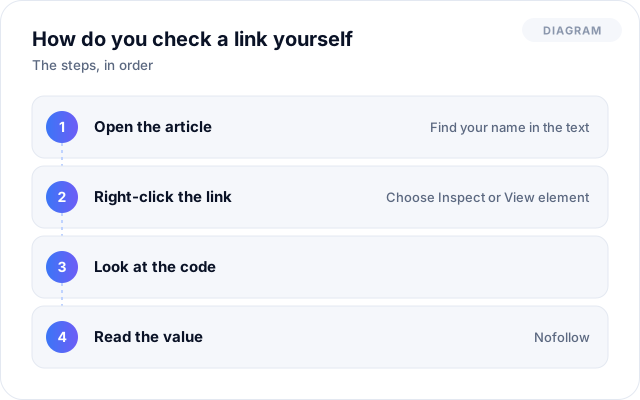
How do you check a link yourself?
- 1
Open the article
Find your name in the text.
- 2
Right-click the link
Choose Inspect or View element.
- 3
Look at the code
Find the word rel inside the link tag.
- 4
Read the value
Nofollow, sponsored or ugc means it is labelled. No rel means dofollow.
A browser extension can show this at a glance if you check many links. Record the result in your tracking sheet so you can see the pattern over time.
What should you focus on instead?
Focus on the things you can control: the relevance of the publication, the quality of your quote and the number of placements you earn each month.
Our HARO link building reports list the link type for every placement, so you always know what you received.
What about the "sponsored" and "ugc" labels?
Two other labels exist. Sponsored is used for paid or advertising links. UGC means user generated content, such as comments and forum posts.
A genuine HARO quote should not carry either one. If a link to you is marked sponsored, check whether the article is actually advertising content and not editorial coverage.
Should you ever ask a journalist about dofollow?
It is better not to. The journalist usually has no control, and the question can come across as treating them like a link supplier.
Focus on giving a good answer. The link policy is the publication's business.
How do you explain this to a client or boss?
- 1
Explain the two types
Dofollow and nofollow, in one sentence each.
- 2
Say who decides
The publication, not you.
- 3
Show the other benefits
Visits, trust and brand mentions.
- 4
Report both types honestly
Never hide nofollow links.
What is a healthy mix?
There is no ideal ratio. Search engines expect a mix. A profile with nothing but dofollow links looks manufactured.
Look at it over time. If you keep earning links from different publications, the mix will balance itself.
What should you aim for?
Aim for relevant, trusted publications first. A nofollow link from a major news site can do more for your brand than a dofollow link from an unknown blog.
What should you read next?
Frequently asked questions
Can I ask a journalist to make a link dofollow?
It rarely works. Link policy is usually set by the publication, not the writer.
Do you guarantee dofollow links?
No honest provider can, because publications decide. We report exactly what each link is.
Will you remove a nofollow tag for me?
No. We do not control publisher settings, and asking is unlikely to work.
Are sponsored labels possible on HARO links?
Not for true editorial quotes. A sponsored label means money was involved.