
This article is part of our complete guide to HARO link building.
What does HARO do?
A journalist writing a story often needs an expert quote. HARO lets them send a request to thousands of possible sources at once.
Sources read the requests and reply to the ones they can answer. The journalist picks the best replies. Everyone gains: the journalist gets a quote, and the source gets a mention.
How did HARO start?
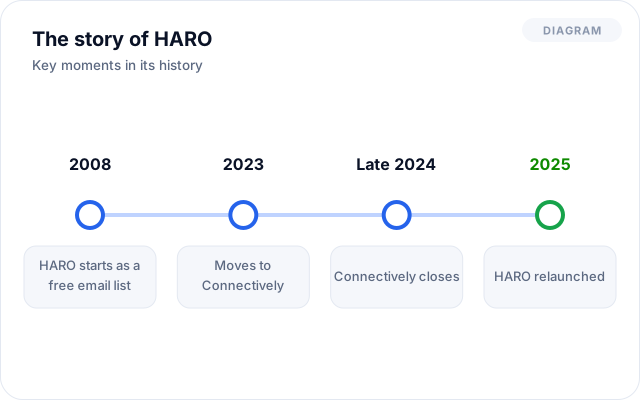
HARO was started in 2008 by Peter Shankman. It began as a simple email list. Journalists sent in questions, and the list went out to subscribers several times a day.
It grew quickly because it was free and easy. It was later bought by a PR software company, and after a merger it became part of Cision.
Why did HARO shut down?
Over time, HARO filled up with low quality replies. Many people sent the same generic answers to every request. Journalists found it harder to spot real experts.
Cision moved HARO to a new platform called Connectively. It added limits and paid features to reduce spam. At the end of 2024, Cision closed Connectively.
How did HARO come back?
In 2025 the HARO name was taken over by Featured, another expert sourcing platform, and the email service was relaunched.
So the HARO you can use today is not run by the same company as before. The idea is the same: journalists ask, experts answer.
Why does HARO matter for SEO?
When a journalist uses your answer, the article often links to your website. That link comes from a trusted publication.
Links like these are one of the strongest signals in search. This is why HARO link building became popular with SEO teams.
How did a HARO email look?
The classic HARO email was simple. It arrived several times a day and listed requests in groups, such as business, technology, health and lifestyle.
Each request had a short summary, the name of the publication if the journalist chose to share it, the question, any requirements and a deadline. Sources replied to a special email address, and the reply was passed on to the journalist.
This format is why HARO spread so fast. There was nothing to learn. If you could read an email and write a clear answer, you could take part.
Who uses HARO?
| Group | Why they use it |
|---|---|
| Journalists | To find expert quotes quickly |
| Bloggers and content writers | To add outside voices to articles |
| Business owners | To gain press mentions |
| PR professionals | To place their clients in the media |
| SEO teams | To earn links from trusted publications |
Journalists come from every kind of outlet, from national newspapers to small trade blogs. Part of the skill is spotting which requests are worth your time.
What are the benefits of using HARO?
- It gives small businesses access to large publications
- It costs little or nothing to try
- The links you earn are trusted by search engines
- Press mentions build confidence with customers
- It strengthens the personal brand of the expert who is quoted
For many companies, HARO is the only realistic route to a mention in a publication they could never reach through advertising.
What are the limits of HARO?
HARO is not a guaranteed source of links. It is worth knowing the limits before you start.
- Most replies are not used, because journalists receive many
- You cannot choose which publication quotes you
- You cannot control the wording or the link
- It needs daily attention and fast replies
- Results build over months, not days
People who expect instant results are often disappointed. People who treat it as steady, long term work tend to do well.
How is HARO different from a press release?
A press release pushes your news out and hopes someone picks it up. HARO works the other way. The journalist already has a story and is asking for help with it.
That makes HARO more efficient. You are not trying to create interest. You are answering a question that someone has already asked.
How do you get started with HARO?
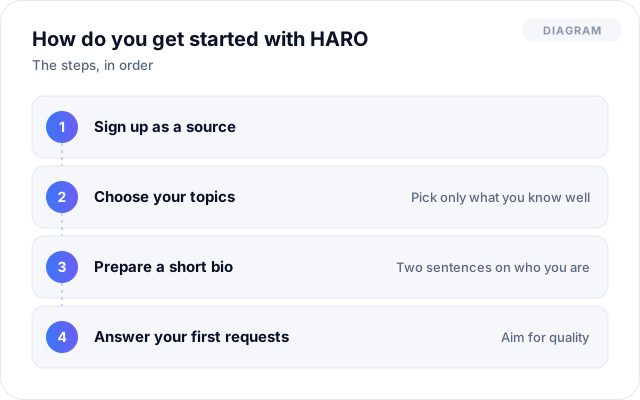
- 1
Sign up as a source
Use your real name and a work email.
- 2
Choose your topics
Pick only what you know well.
- 3
Prepare a short bio
Two sentences on who you are.
- 4
Answer your first requests
Aim for quality, not volume.
Our guide on how to sign up for HARO walks through each step, and how HARO link building works explains the full process.
What is the difference between HARO and a PR agency?
A PR agency works for you on a retainer. It builds relationships with journalists, writes press releases and pitches your story. HARO is a place where journalists come to you with questions.
| HARO | PR agency | |
|---|---|---|
| Cost | Free to low cost | Often thousands per month |
| How it works | You answer requests | The agency pitches stories |
| Control | Low | Higher |
| Best for | Expert commentary and links | Launches and brand campaigns |
Many companies use both. HARO fills the gaps between larger campaigns.
What makes a HARO reply stand out?
- It answers the exact question
- It comes from a named expert with a clear role
- It contains a specific example
- It arrives early
- It reads like a person wrote it
These are the same points that matter on every journalist platform. You can see them applied in our HARO pitch template.
Is HARO legitimate?
Yes. It has been used by journalists at major publications for many years. It is not a scheme and it is not a link marketplace. Nobody pays for placements, and the journalist chooses freely.
Be careful about copies. Fake sites sometimes imitate well-known names. Always go to the official site directly.
What should you do next?
- 1
Learn the process
Read how HARO link building works.
- 2
Prepare your profile
Bio, headshot and topics.
- 3
Start with two platforms
HARO plus one other.
- 4
Track your results
A simple sheet is enough.
If you would rather have the work done for you, see our HARO link building service.
Is HARO the only option now?
No. While HARO was closed, reporters moved to other platforms. Qwoted, Featured, Source of Sources and Help a B2B Writer are all in use.
Smart campaigns cover several platforms, not one.
What should you read next?
Frequently asked questions
What does HARO stand for?
Help a Reporter Out.
Who owns HARO now?
The HARO name was taken over by Featured in 2025. Ownership can change, so check the official site for the latest details.
Is HARO only for American media?
Most requests come from US and UK publications, but journalists from many countries use it.
Can I use HARO if I am not a native English speaker?
Yes. Clear, simple English and real expertise matter more than polished writing.
Is HARO good for SEO?
Yes. It is one of the most reliable ways to earn editorial links from trusted publications.