
This article is part of our complete guide to HARO link building.
What are HARO backlinks?
A HARO backlink is a link to your website that appears in an article after a journalist uses your answer to one of their requests. The request reaches you through HARO, short for Help a Reporter Out, or through a similar journalist request platform.
In one line: a HARO backlink is an editorial link you earn by giving a journalist a quote they decide to publish.
Three things set it apart from most other links:
- A journalist or editor chooses it, because your answer helps their story
- You do not pay the publication for it
- It usually sits inside a real article, next to your name, job title or company
People also call them HARO links or journalist links. They belong to a wider group called editorial backlinks. The table shows how they compare with other common links.
| Link type | How you get it | Who decides | Main risk |
|---|---|---|---|
| HARO backlink | A journalist uses your answer | The journalist and the publication | Time spent on pitches that are not used |
| Guest post link | You write an article for a site | The site owner, sometimes for a fee | Little value if the site sells links |
| Paid link | You pay for the link | The seller | Breaks Google rules if it passes ranking credit |
| Directory or profile link | You add your own listing | You | Little value on weak directories |
For a closer comparison, read HARO vs guest posting and HARO vs paid links.
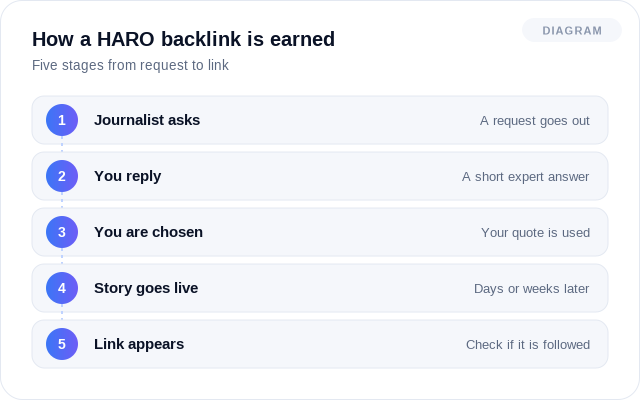
How is a HARO backlink earned?
- 1
A journalist posts a request
A reporter writing a story asks for an expert. On HARO, the request goes out in an email digest.
- 2
You answer
You reply with a short answer, your credentials and a line the journalist can quote.
- 3
The journalist chooses
They pick the replies that help the story. Many replies are never used.
- 4
The article goes live
This can take a few days or several weeks. Some stories are dropped.
- 5
The link appears
Your name or company is mentioned, often with a link to your site.
Being featured and getting a link are not the same thing. Some articles name you but do not link to you. If that happens, you can politely ask the writer to add a link. Our guide to unlinked brand mentions explains how.
Our step by step guide to how HARO link building works goes through the daily process in detail.
What is HARO in 2026?
HARO has changed hands, so older guides can be confusing. Here is the short history.
| When | What happened |
|---|---|
| 2008 | Peter Shankman starts HARO as a free email list |
| 2023 to 2024 | Cision moves HARO to a new platform called Connectively |
| End of 2024 | Cision closes Connectively |
| April 2025 | Featured buys HARO and brings the email service back |
| 2026 | Featured brings back Connectively as a platform alongside HARO |
Today HARO is a free newsletter that Featured sends three times a day. Connectively returned in 2026 as its sister brand: a platform where experts answer publisher questions, for people who want more than an email. It took over the expert platform that used to run under the Featured name. See Connectively in 2026.
For the longer story of the first years and the shutdown, read what is HARO.
Are HARO backlinks dofollow or nofollow?
It depends on the publication. Some give sources a normal link, often called dofollow. Others mark outside links as nofollow, and some mark them as sponsored. You cannot choose, and usually the journalist cannot either.
| Link in the code | What it signals to Google |
|---|---|
| No rel value (dofollow) | A normal link that can pass ranking credit |
| rel="nofollow" | The site does not want to vouch for the page or pass credit to it |
| rel="sponsored" | The link is part of an advert or a paid deal |
Since 2019 Google has treated nofollow, sponsored and ugc as hints rather than strict rules. In practice, expect a followed link to do more for rankings, and treat the others as useful for visits, trust and brand mentions.
What real placements look like
On 26 November 2026 we checked the link code in five articles that quoted or mentioned our clients after journalist outreach on HARO and similar platforms. Five articles are a small sample, so these are examples, not a percentage. Publications can change their links later.
| Publication | Article topic | Client type | What the link code showed |
|---|---|---|---|
| Salon | Going into debt for a trip | Finance | No rel value, so followed |
| Kiplinger | A retirement planning question | Mortgage | No rel value, so followed. The link is on the expert name |
| GOBankingRates | Millionaires moving to Puerto Rico | Real estate | Only noreferrer and noopener, so followed |
| Family Handyman | What tariffs mean for homeowners | Real estate | Nofollow |
| TechRadar | Preserving yourself with AI | Artificial intelligence | Sponsored, added to a link routed through an affiliate tool |
Two lessons come out of this. Check the link on your name as well as the link on your company. And some publishers send outside links through their own tools, which can add a label you did not expect.
Some platforms show the likely link type before you answer. On Connectively, the Pro plan and above list link type and domain authority, which helps if that matters to your campaign. For more detail, read are HARO backlinks dofollow and do nofollow links still help SEO.
Why are HARO backlinks valuable?
- Authority: a followed link from a trusted publication can help your site rank
- Relevance: the link sits in an article about your subject, surrounded by related words
- Referral visits: readers who want more can click through to your site
- Trust: you can show where you were featured on your website and in sales material
- Brand searches: people who read your name may search for you later
- AI search: tools such as ChatGPT, Perplexity and Google AI answers draw on published sources, so mentions give them something to find
- Low risk: a link that a journalist chose to add is not a bought link
No single link guarantees a ranking. Results depend on your pages, your competitors and how many good sites link to you over time. A few strong, relevant links usually do more than many weak ones. Learn how to judge them in high quality backlinks.
How to judge a request before you answer
- Is the publication relevant to your field or your customers?
- Does it have real readers, named writers and editors?
- Does it usually link to the people it quotes?
- What is its domain rating, and does it still publish original work?
- Would you be proud to show the mention to a customer?
DR, or domain rating, is a score from 0 to 100 from the tool Ahrefs. It is useful for comparing sites, but it is not a Google score. See DR vs DA.
Are HARO backlinks safe for Google?
A link that a journalist chooses to add to a useful article is an editorial link. Problems start when money or favours are exchanged to move rankings.
Google lists these among the examples of link spam:
- Buying or selling links for ranking purposes, including paying for posts that contain links
- Giving goods or services in exchange for links
- Excessive link exchanges between sites
- Advertorials and paid articles with links that pass ranking credit
- Automated programs or services that create links to your site
Google says paid links are acceptable only when they carry rel="nofollow" or rel="sponsored".
Be careful with offers that promise a link on a named publication, always dofollow, on a fixed date. No honest provider controls those things, because publications decide. Offers like that are often paid placements under another name. Our guide to HARO agency red flags lists what to watch for, and white hat link building explains the safe approach.
How do you get HARO backlinks, step by step?
The method is simple. Doing it well every week is the hard part.
1. Prepare your source profile
Journalists check who you are before they quote you. Prepare these once and reuse them:
- Your name, job title and company
- A two or three sentence expert bio
- A clear, recent photo
- Your homepage, plus one useful page you would be happy for a reader to land on
- A short list of topics you know from your own work
2. Subscribe to HARO and one or two other sources
HARO is free. Follow our guide to signing up for HARO. Add one or two other platforms so you do not depend on a single source of requests.
3. Filter hard
Read each digest and keep only the requests where you meet every requirement. If a journalist asks for a licensed professional in a certain place, reply only if that is you. A short list of good matches beats a long list of poor ones. HARO categories can help you decide where to look first.
4. Research before you write
- What is the story about, and who will read it?
- What exactly did the journalist ask for, and in what format?
- Which real example, number or lesson from your work answers it?
- What can you add that other replies will not?
5. Write a reply the journalist can paste
Lead with the credential that matters for this story, answer the question and give one line that works as a quote. Brett Farmiloe, whose company owns HARO, suggests replies of four to eight helpful sentences. Our HARO pitch template and examples and subject line ideas will save you time.
6. Send it while the request is fresh
Journalists work to deadlines. Send your reply as soon as it is complete and useful. The aim is to be the first great answer, not simply the first answer. See our notes on response time.
7. Follow the rules
- Answer only what was asked
- Do not pitch your product when the journalist asked for advice
- Do not use a journalist's address for other marketing
- Do not send the same reply to many requests
- Be honest about who you are and what you have done
Breaking the rules can cost you the account. Read the HARO rules before your first pitch.
8. Track what happens
Keep a simple sheet with the request, the date you replied, the publication and the result. After a month you will see which topics get chosen, and you can answer more of those.
What does a good HARO pitch look like?
This is an invented example that shows the shape. Do not copy it. Write about your own experience.
Subject: Remote hiring: what we check in week one
Hi Sam, I run operations at a 14 person software company, and we have hired remotely for four years.
The one thing we check in week one is whether a new hire asks questions in shared channels. People who ask early solve problems faster, so we tell them on day one that a question is never a sign of weakness.
Happy to share how we set that up.
Jordan Lee, Head of Operations, Example Co, example.com
Why this works:
- The first lines show why the writer is qualified
- It answers one question with one clear idea
- The middle can be quoted exactly as written
- It ends with the name, title, company and website the journalist needs
See more in how to pitch journalists.
What does HARO's own data say about winning pitches?
In 2026 HARO published figures about the pitches on its platform. These are HARO's own numbers, so read them as a guide.
| Topic | What HARO reported | What it means for you |
|---|---|---|
| Success | About 1 in 3 human-written pitches were featured, against about 1 in 10 fully AI-written ones, across 1,394,740 tracked pitches | Write the answer yourself |
| AI share | About 21% of pitches are fully AI-generated | Generic replies are common, so a real example stands out |
| AI filter | About 35% of journalists choose not to receive fully AI-written pitches | Many reporters will never see an AI-only reply |
| Screening | About 32% of journalist requests are rejected before they are sent out | HARO screens requests as well as sources |
| Bans | An account is banned roughly every 23 minutes, mainly for spam and rule breaking | Quality protects your account |
Sources: HARO's study of AI and human pitches (24 November 2026) and HARO's 2026 email data (August 2026).
Two cautions. Featured means your answer was used, which does not always include a link. And HARO says its AI detector can be wrong, so treat the figures as a pattern, not a promise.
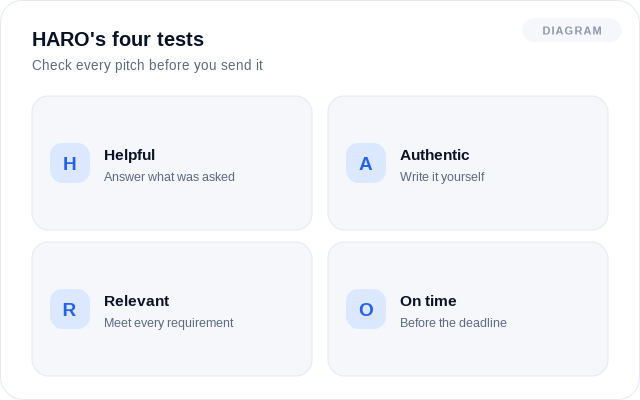
HARO sums up the winning approach with its own letters: be helpful, authentic, relevant and on time. If you use AI, use it to research or to start a draft, then rewrite it until it sounds like you. Our guide to AI and HARO pitches goes further.
Which platforms besides HARO can earn these links?
The same method works on other request services. Covering a few gives you more chances without lowering your standards.
| Platform | How it works | Read more |
|---|---|---|
| HARO | Free email digest of journalist requests | HARO sign up |
| Connectively | Experts answer publisher questions, with free and paid plans | Connectively guide |
| Qwoted | Request platform with verified reporters | Qwoted review |
| Source of Sources | Free email list started by the founder of HARO | SOS guide |
| Help a B2B Writer | Requests for business topics | Help a B2B Writer guide |
| SourceBottle | Journalist requests with a focus on Australia | SourceBottle guide |
Plans and prices change, so check each site before you join. Our list of free HARO alternatives is a good place to start.
Which mistakes cost you links?
| Mistake | Better |
|---|---|
| Replying to every keyword match | Reply only when you meet every requirement |
| Sending an AI draft as it is | Use tools for research, then write in your own words |
| Opening with your company story | Answer the question in the first lines |
| Missing the deadline | Read each digest soon after it arrives |
| Leaving out your credentials | Add name, title, company and why you qualify |
| Asking for a dofollow link | Let the publication apply its own policy |
| Chasing the journalist | Follow up only if they ask, or once, politely, about a missing link |
More examples are in common HARO mistakes and how to follow up with a journalist.
Where should HARO links point?
The journalist decides the page and the anchor text. You can still make a good choice easy.
- Offer your homepage and one useful inner page, such as a guide or a page with your own data
- Make that inner page worth linking to on its own
- Link from it to your main service or product pages, so its value spreads
- Do not ask for keyword anchor text
Over time this gives you links to more than your homepage, which helps the pages you want to rank. Read about anchor text and how many backlinks you need to rank.
How long do HARO backlinks take?
A reply can be used within days, or the article may appear weeks later. Plan in months, not days.
| Stage | Typical timing |
|---|---|
| Setting up your profile | A day or two |
| First replies | The first week |
| First links for our clients | Often within two to four weeks |
| Ranking changes | Often 60 to 90 days after a link goes live, sometimes longer |
These are typical figures, not promises. Your industry, your expertise and the competition all change the pace. See the HARO link timeline and what affects your HARO success rate.
How do you find and check your HARO backlinks?
Journalists do not always tell you when a story is published. Check for yourself.
- 1
Search for your name and brand
Search your full name and company name in quotation marks, and set up alerts for both.
- 2
Open the article and inspect the link
Right-click the link, choose Inspect and look for a rel value such as nofollow or sponsored.
- 3
Check Google Search Console
The Links report lists sites that link to you. New links can take a while to appear there.
- 4
Record the details
Note the publication, the article address, the anchor text, the link type and the date.
- 5
Ask about a missing link
If you were named without a link, send one short, friendly note. The publication has the final say.
Our guide to tracking HARO mentions shows simple ways to do this each week.
Should you do it yourself or use a service?
| Question | Do it yourself | Use a service |
|---|---|---|
| Cost | Free on HARO, plus your time | A fee per package or per link |
| Time | Daily reading and writing | A briefing, then approvals if you want them |
| Who writes | You | A team, based on what you know |
| Results | Depend on your fit and your consistency | A provider may guarantee a number of links |
Do it yourself if a real expert in your business has time every day. Use a service if that time is worth more than the fee, or if replies keep slipping past deadlines.
Our packages are Starter with 5 links for $1,250, Premium with 10 links for $2,300 and Growth with 15 links for $3,000. Every link is from a publication with a DR of 50 to 99. Publications decide whether a link is dofollow, and we report the type of each one. Compare what HARO link building costs, read how to compare services or see our HARO link building service.
Are HARO backlinks worth it?
They are worth it when someone in your business has real expertise to share and you can wait a few months for the effect. They are a poor fit if nobody can be named, if you need results this week or if you want hundreds of links at once.
A simple test: pick ten recent requests in your field and count how many you could answer from your own experience. If you can answer several well, start. If you cannot answer any, build your knowledge or your public profile first. Read is HARO worth it for a fuller check, or see a client case study.
What should you read next?
Frequently asked questions
What is a HARO backlink?
A link to your site that a journalist adds after using your answer to a request sent through HARO or a similar platform.
Are HARO backlinks free?
HARO is free to subscribe to, and you do not pay the publication. The cost is your time, or the fee if a service does the work for you.
Are HARO backlinks dofollow?
Some are and some are not. The publication decides. See are HARO backlinks dofollow.
Are HARO backlinks safe for SEO?
A link that a journalist chooses to add is an editorial link. Paying for links that pass ranking credit breaks Google rules.
How many HARO backlinks can I get each month?
It depends on your expertise, your topics and your time. Nobody can promise a number for a campaign you run yourself, and relevant replies matter more than volume.
Can I use AI to write HARO pitches?
You can use it to research or to start a draft. HARO checks pitches for AI writing and about 35% of its journalists filter out fully AI-written ones, so rewrite it in your own words.
Do HARO backlinks help with ChatGPT and AI search?
AI tools build answers from published sources, so media mentions can help your brand be found. Nobody can guarantee a mention in an AI answer.
What if I am quoted without a link?
Thank the writer and politely ask whether they can add one. The publication has the final say.